
Universities often position their efforts around inclusion and closing awarding gaps as neutral and well-intentioned. Yet, despite years of reform, inequitable outcomes persist – especially for students who are racialised, disabled, or both. Why? Because universities usually address race and disability separately through distinct policies, overlooking the way these identities intersect to shape students’ educational experiences.
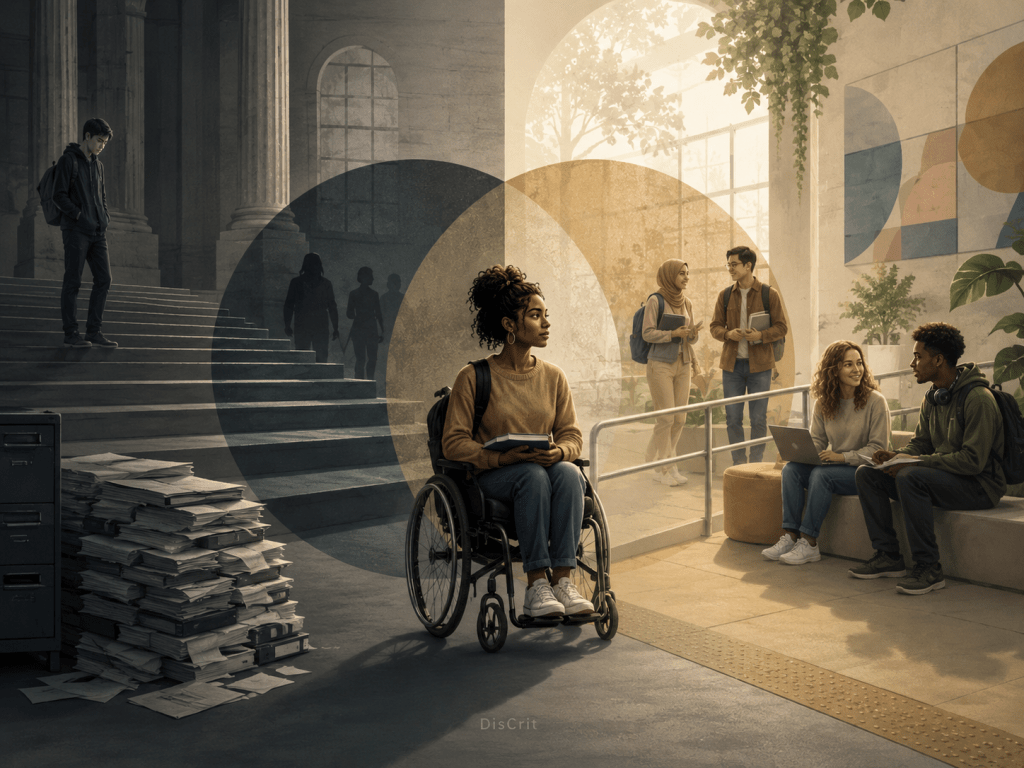
Disability Critical Race Theory (DisCrit) offers a vital perspective. Instead of seeing race and disability as individual traits, DisCrit frames them as intersecting systems of power that influence how ability and merit are defined in education. Practices labelled “inclusive” can inadvertently reproduce exclusion if they don’t challenge the structures that produce inequity. Racism and ableism aren’t rare glitches in the system—they are built into the very fabric of our institutions.
Take, for example, the widespread reliance on student disclosure for adjustments. Presented as pragmatic, these systems put the burden on students to prove and justify their needs, framing disability as an individual problem. Racialised students, who may face greater stigma or distrust, are often the least likely to access this support – even though they might benefit the most.
The same pattern appears in how universities address awarding gaps. Gaps are often treated as indicators of student deficit rather than products of teaching, assessment, and institutional culture. Even the language of “gaps” shifts the focus away from systemic issues and towards individual shortcomings. DisCrit invites us to ask: Who is expected to adapt? Whose ways of learning are considered “normal”? And why do certain groups consistently achieve less well?
This challenge is particularly acute in science and healthcare, where objectivity and meritocracy are core values and disability is often viewed through a clinical lens. But supposedly neutral assessments, like high-stakes exams or narrow participation rules, often privilege certain types of thinking and communicating. Meanwhile, textbooks and case studies still frequently centre white, male bodies – impacting not only student belonging but, in healthcare, even patient outcomes.
DisCrit isn’t about rejecting individual differences or biological realities. It’s about asking whose needs are systematically overlooked and why. Simple changes – like offering alternative ways to participate, diversifying reading lists, or seeking student feedback – can make a real difference. Moving beyond technical fixes means examining the assumptions that underpin our systems and being open to uncomfortable questions about power and privilege. If higher education is serious about equity, it can’t rely on good intentions or surface-level reforms. Engaging honestly with how power operates within our institutions is essential. Only then can we build systems that are truly inclusive, accurate, and just.




 Bioscience Scholarship Research at NTU
Leave a comment